And now for something from the lighter side of life...
So today I finished my goal of watching all eleven Star Trek
movies in order (yes, I am that lame) and as I have had some time to reflect
now on the different captains, crews, stories and ships and the voyages of all
the different star ship Enterprises that appear in the feature length movie
franchise, I have made some observations that I’m ready to share with the
citizens of the internet.
First of all, even as a self-identified Trekkie and long
time follower of the franchise – it has to be said that a few of these movies
are absolutely terrible! By and large the accepted rule of thumb with the Star
Trek film franchise is that the odd-numbered movies are awful and the even
numbered movies are great or at least passable for entertainment value. This
pattern largely holds true in experience with the even numbered films being the
most successful and the odd numbered movies being critically reviled even into
the Next Generation films (7-10) that aren’t officially numbered. The theory
breaks down when you get to the latest film “Star Trek”, which is J.J. Abrams
first foray into the Star Trek universe and is unofficially number 11 as it is
technically a sequel and NOT a reboot as is most commonly believed (more on
that later).
So rather than give a synopsis or evaluation of each
individual film (which could take a long time and would be rather
uninteresting) I want to quickly give an overview of the film franchise as a
whole and highlight some notable things that stuck out to me and then afterward
I’ll go out on a limb and give my nod to the best and the worst of the film
franchise in a move that is sure to infuriate the die-hard faithful in my
readership. So here goes.

Star Trek: The motion picture begins with the ominous
arrival of a dangerous energy cloud that of course threatens the very existence
of Earth (a theme that would be repeated in various forms in films IV, VIII, and
XI) and the first thing we notice is how OLD all of the original crew have
gotten in the 10 years since the end of the original series. William Shatner in
particular did not age well, nor did DeForest Kelley, James Doohan or Walter
Koenig. All of the crew look significantly older than their characters should
be. An indeterminate amount of time has
passed in the story universe but we know that Kirk cites his 5 years at the
helm of the Enterprise as the reason for his special qualifications for taking
control of the ship so it would seem that not that much time has passed in
screen time since the end of the original series – which makes the age of the
crew all the more jarring when we first see them on screen. The second thing
that we notice is that the crew have all scattered. Kirk is now an admiral,
Spock seems to have resigned his commission and is searching for some sort of
inner peace on Vulcan and McCoy has retired. The Enterprise has gone through
some sort of extensive retro-fit and there is a new command crew in charge.
Captain Will Decker, the man hand-picked by Kirk to command his ship is getting
the crew ready for its shakedown voyage but the crisis forces crew and ship
into premature service to save Earth.
Which of course they do after reassembling the original
bridge crew and killing off the interesting new characters that could steal
attention from the stars (interestingly the characters of Decker and the
telepathic Lieutenant Ilia who shared a romantic past became the templates for
the more famous and enduring characters of Will Riker and Deanna Troi in The
Next Generation continuity) the movie ends without much resolution to the
characters’ futures. Kirk is still an admiral, Spock’s future in uncertain and
McCoy never officially re-enlists.

In Star Trek II we begin with the first mention of the
famous Kobayashi Maru test at Star
Fleet Academy. A new character, a Vulcan
female played by a strangely miscast young Kirstie Alley (Saavik would later be
recast for Star Trek III). We learn in this scene that Kirk is still an
admiral, that Spock is now the captain of the Enterprise and that it has been
reassigned as a training ship for cadets and young officers. In the next scene
we learn that Chekov has been reassigned to the crew of the USS Reliant and
once again the main crew is scattered across different assignments needing a
crisis to pull them together. That crisis is Kahn – Ricardo Montalban reprising
his role as the genetically augmented superhuman who is this time out for
revenge against the man who marooned him and his crew in the original series
episode Space Seed. Star Trek II is nostalgically remembered by many as
possibly the pinnacle of the original six movies but frankly I think that
nostalgia is clouding better judgement. Kahn is a mediocre villain at best and
the genesis device which serves as the ultimate weapon that endangers the crew
is one of the worst MacGuffins in all of Star Trek lore. The only thing that
makes this movie the least bit memorable is the sacrifice of Spock at the
climax of the film. Followed by a funeral service that even had be tearing up
the franchise follows it up by immediately squandering all the good will they
built with the horrible movie that is Star Trek III.
 The less that is said about Star Trek III the better, but
the consequences of the plot is that Kirk’s newly discovered son is killed
(setting up a major plot point for movie VI), Spock is resurrected and the
Enterprise is destroyed. Oh, and we learn definitively that Christopher Lloyd,
while making a great Doc Brown, makes a horrible Klingon. That distinct voice
just does not work.
The less that is said about Star Trek III the better, but
the consequences of the plot is that Kirk’s newly discovered son is killed
(setting up a major plot point for movie VI), Spock is resurrected and the
Enterprise is destroyed. Oh, and we learn definitively that Christopher Lloyd,
while making a great Doc Brown, makes a horrible Klingon. That distinct voice
just does not work.
Star Trek IV is also fondly remembered by most fans of the
series. It is also known as the movie with no Enterprise, very little action in
Space and of course Whales. This is the second time an large and powerful probe
of some type is inexplicably headed for Earth and has threatened human
existence. The plot takes the crew back in time to 1980s San Francisco in what
ends up being one of the most lighthearted and funny films in the series. At
the end of the film a new Enterprise is unveiled (NCC-1701A) and Kirk is busted
back down to the rank of captain finally getting things back where they belong
in the Star Trek universe and all but guaranteeing a fifth film in a few years
time; which is a shame – because Star Trek V was awful. Anytime you mix themes
of getting old (a theme that would be much better realized in the sixth film),
space exploration and the search for God within the campy universe of Star Trek
– you know that good things are not forthcoming.
 Star Trek VI is where I think the original crew really
shines in the film universe. The film is a social commentary on the western
world coming to terms with the collapse of the Soviet Union and the passing of
a generation into irrelevance. This is demonstrated not only by the reflections
on age and retirement, but also in the comparison of the aging Constitution
class Enterprise with the new and powerful USS Excelsior under the command of
former Enterprise helmsman, Captain Sulu. I think also that the legendary
Christopher Plummer delivers what is probably the best performance ever in the
role of a lead villain in a Star Trek film.
Star Trek VI is where I think the original crew really
shines in the film universe. The film is a social commentary on the western
world coming to terms with the collapse of the Soviet Union and the passing of
a generation into irrelevance. This is demonstrated not only by the reflections
on age and retirement, but also in the comparison of the aging Constitution
class Enterprise with the new and powerful USS Excelsior under the command of
former Enterprise helmsman, Captain Sulu. I think also that the legendary
Christopher Plummer delivers what is probably the best performance ever in the
role of a lead villain in a Star Trek film.
Star Trek Generations (VII) is by all accounts a movie that
only existed to kill off Kirk and give the crew of The Next Generation ‘permission’
to start making movies. It also features the only canon appearance of the
Excelsior class Enterprise B (The Enterprise C had been previously featured in
the TNG episode “Yesterday’s Enterprise” and the destruction of the Enterprise
D – which was to give the Next Generation movie franchise a fancy new ship to
carry on with; which set-up the events of Star Trek First Contact (VIII) and
the debut of the fancy new Sovereign class Enterprise E.
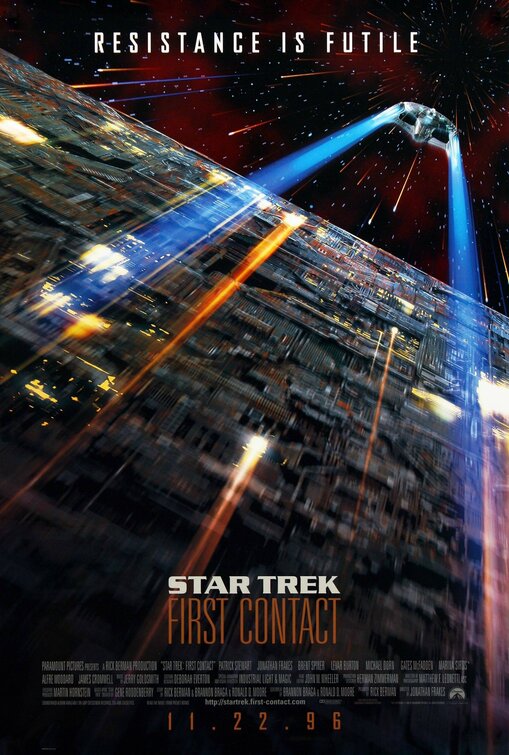
First Contact was undoubtedly the most frightening of the
eleven feature films with a deliberate attempt to mix a bit of the space horror
genre into the plot. It balanced this with lighthearted shenanigans on 22nd
century Earth trying to get a notoriously irresponsible and drunk Zephram Cochrane
to successfully launch the first warp ship in human history to preserve their
timeline. It also started the trend of Data being the unquestioned secondary
lead in the crew for plot attention and the trend of finding excuses for Worf
to keep coming along for the adventure since he was no longer an official part
of the crew as he was assigned to Deep Space Nine.
Following First Contact was Star Trek Insurrection (IX) which
was notable not only for its general lameness, but also for being the film
where Riker and Troi rekindle their romance (an important plot point in the
next movie). Stuff happens, stuff blows up. Worf inexplicably ends up along for
the ride and the good guys win.
Star Trek Nemesis (X) was the fourth and final movie in the
Next Generation franchise. The whole theme of the movie was goodbyes. Riker and
Troi were married in the opening scenes and Will had accepted the post as the
captain of the USS Titan. Beverly Crusher had been (once again) appointed the
head of Starfleet Medical. Worf was once again somehow there (and yet
officially not there because he wasn’t a part of the crew) and Data did his
best impression of Spock saving the ship by sacrificing his own life in the
climax of the film. Being an even numbered film and featuring a fearsome new
foe with ties to the Romulan Empire it should have been a great movie, but at this
point the air was out of the Next Generation crew’s balloon and the whole movie
was just one long epilogue to the TV and film series that spawned it.
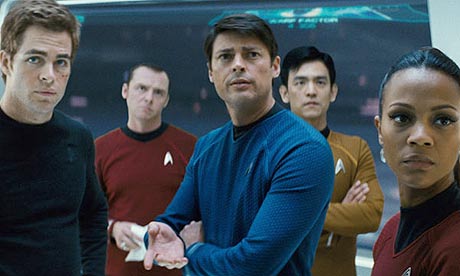
Star Trek (XI) the reboot that wasn’t really a reboot would
follow seven years later with a new take on the original series crew and a new
vision for the franchise courtesy of J.J. Abrams. It turned the tables on Kirk making him an outsider fighting his way
in, turned Spock into a much more human character (and gave him a romantic
relationship with Uhura), remade the Enterprise into some sort of hybrid between
quasi industrial and Apple computers type of ship (seriously, the Engineering
section looks like it belongs on a 20th century steam ship while the
bridge looks like it’s a part of Apple headquarters in Cuppertino). It also
changed history in a big way by destroying one of the most important planets in
the Federation – Vulcan. Yet by a stroke of genius Abrams incorporated a time
travel element that kept it firmly in the original continuity as a sequel to
Nemesis while creating a new timeline that essentially frees him from sticking
to the original canon in subsequent sequels.
So after wasting so much of my life watching all of these
films in order (not all in one day thank goodness) I do have some awards for
the best and worst aspects of the film franchise as we get ready for the much anticipated 12th film
due in theatres this May.
Best Captain:
This is the question that is most likely to divide the fan base in half but I
think that hands down the best captain in the series has to be Picard. Even
with only four moves to Kirk’s seven (and I count Kirk Alpha as a different
captain) he distinguished himself as a much more capable and intelligent
officer than Kirk ever did. How Picard is not yet an admiral (and Janeway
is!?!) is beyond me.
Worst Villain:
The whaling industry. Seriously. In Star Trek IV Leonard Nimoy, who directed
the film, wanted to have such a strong environmental message that he wrote no
villain into the plot. The antagonist was us and the way we treated the
environment. Lame.
Best Villain:
General Chang from Star Trek VI. You don’t get much better than a Klingon who
recites Shakespeare as he tries to kill you and ruin the plan for peace between
the Klingons and the Federation. That and Christopher Plummer.
Best Ship: Hands down
that has to go to Picard’s Enterprise E, although I am also partial to Sulu’s
Excelsior.
Most Bizarre Casting
Choice: Christopher Lloyd as the Klingon Commander Kruge. I spent the whole
movie waiting for him to invent the flux capacitor.
Worst film: Star
Trek the Motion Picture is hard to beat in this category but Star Trek III:The
Search for Spock gives it a run for its money.
Best Film (I-VI):
Certainly the Undiscovered country wins this award
Best Film (VII-X):
Hard to find a better Next Generation film than First Contact. How can you go
wrong with the Borg?
Best Film overall:
I’m going to offend all the traditionalists here and go with Star Trek (XI) on
this one. Abrams has re-imagined the Star Trek universe in a way that is fresh
and modern and has found a way to both honour the source material and canon
while simultaneously freeing himself from it.
Bonus Category –
Worst Uniforms: Star Trek the Motion Picture. What were they thinking? Who knew that the 70s would be back in style in
the 23rd century.


No comments:
Post a Comment